CA CTF 2022: Exploiting vulnerable Elliptic Curve parameters - MOVs Like Jagger
Exploiting vulnerable Elliptic Curve parameters, WizardAlfredo shares his write-up of MOVs Like Jagger from Cyber Apocalypse CTF 2022.

Table of Contents
In this write-up, we'll go over the solution for the medium difficulty crypto challenge MOVs Like Jagger that requires the exploitation of a vulnerable elliptic curve.
Challenge Description 📄
While following the breadcrumbs from the secret messages you managed to recover from Broider, Bonnie gathered more information from his well trusted "Tsirakia" and found out that the messages were about the destinations of a STS (Space Transportation Ship). The STS, named "Paketo", is a notoriously large spaceship that transports military supplies for the Golden Fang mercenary army. After spending some time observing the seemingly random trajectory of Paketo, you and Paulie manually plotted the delivery locations and realized that the STS's orbit forms an elliptic curve. Your spaceship's advanced technology GPS has calculated the exact parameters of the curve. Can you somehow predict Paketo's final destination and hijack it?
The application at-a-glance 🔍
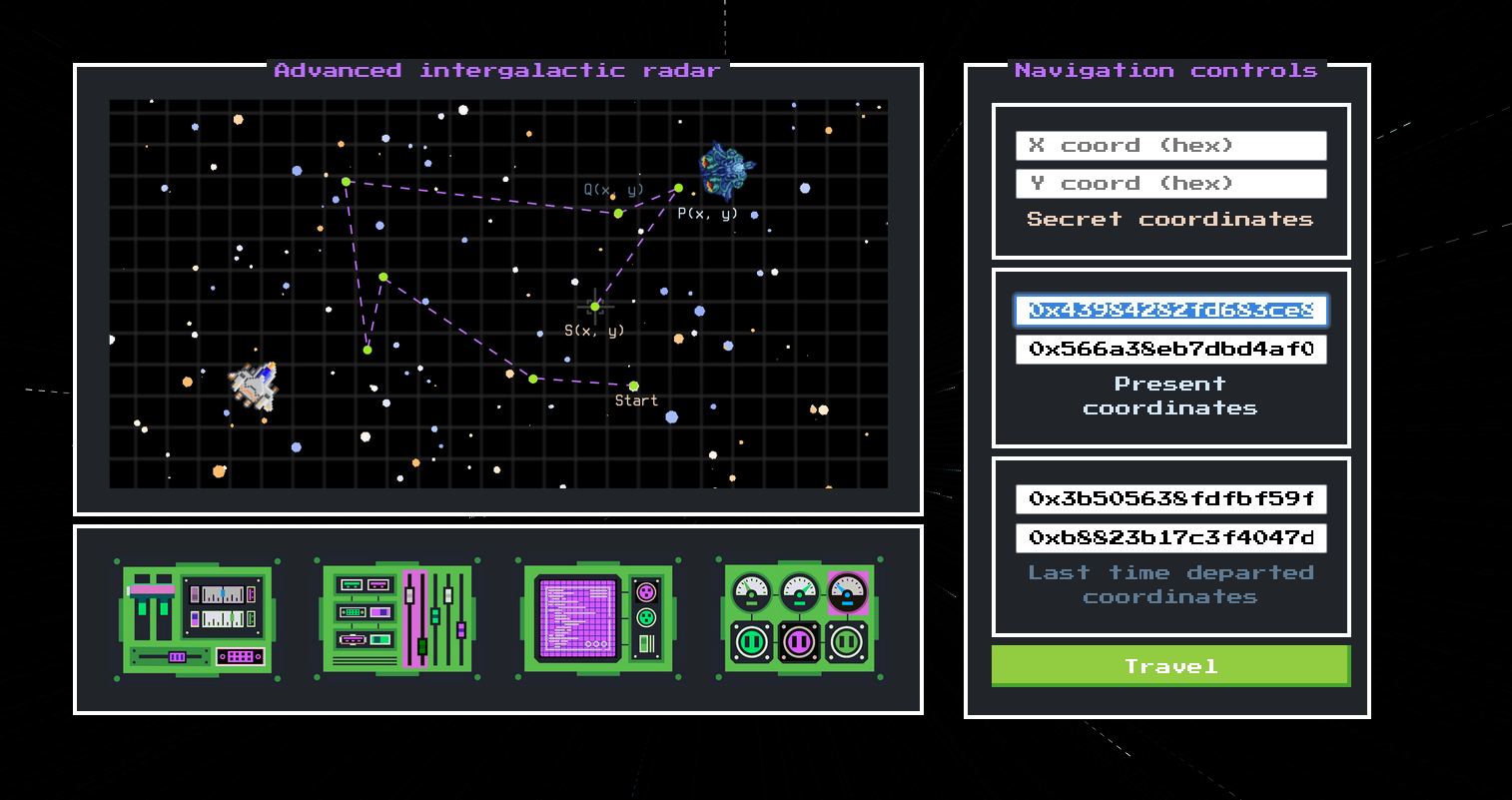
If you visit the homepage of the application, you will see a GPS like system indicating the movement of the STS called "Paketo". The only information available to us is the current coordinates and the coordinates from which the ship started.
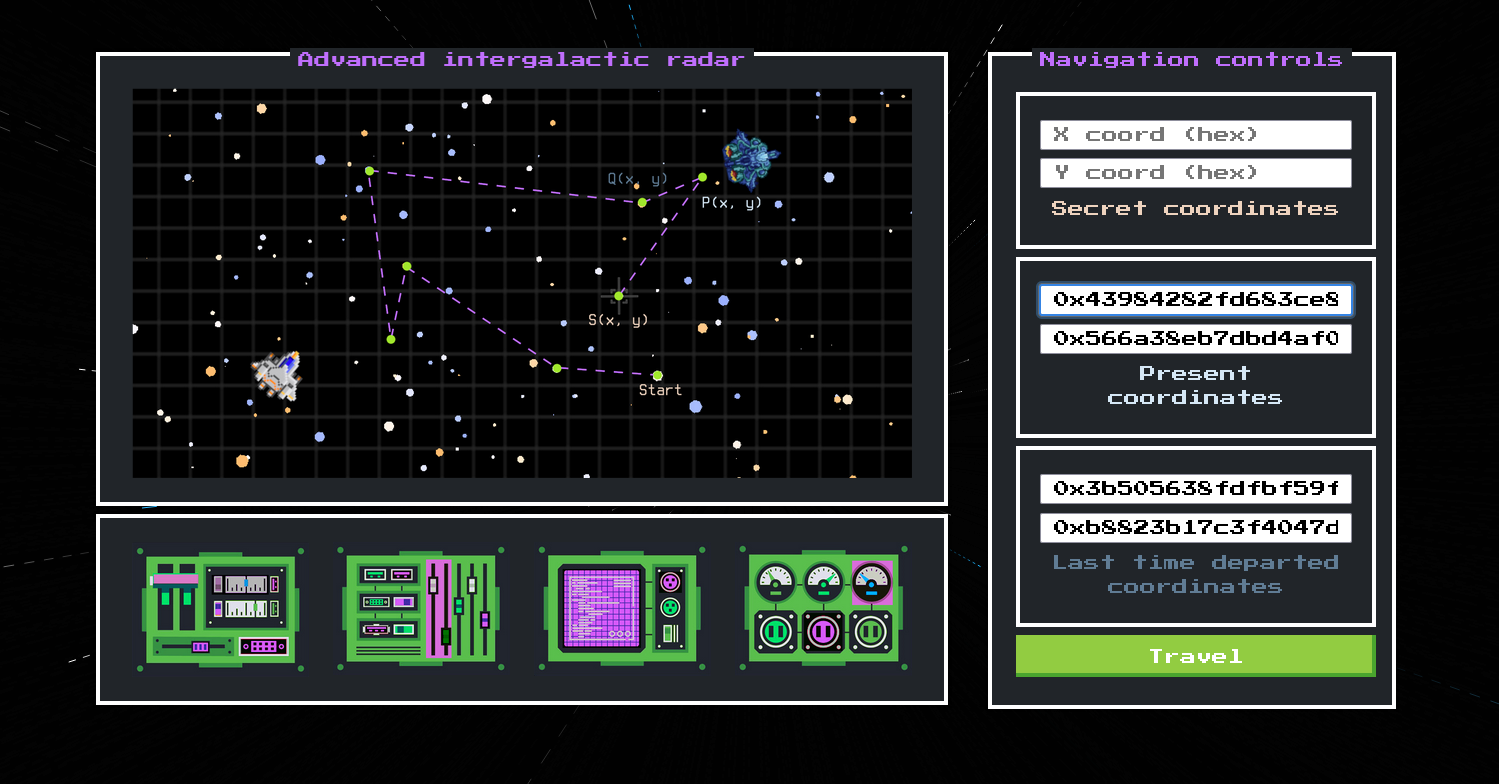
We can try entering random data into the secret coordinates field and see what happens when we press the travel button.
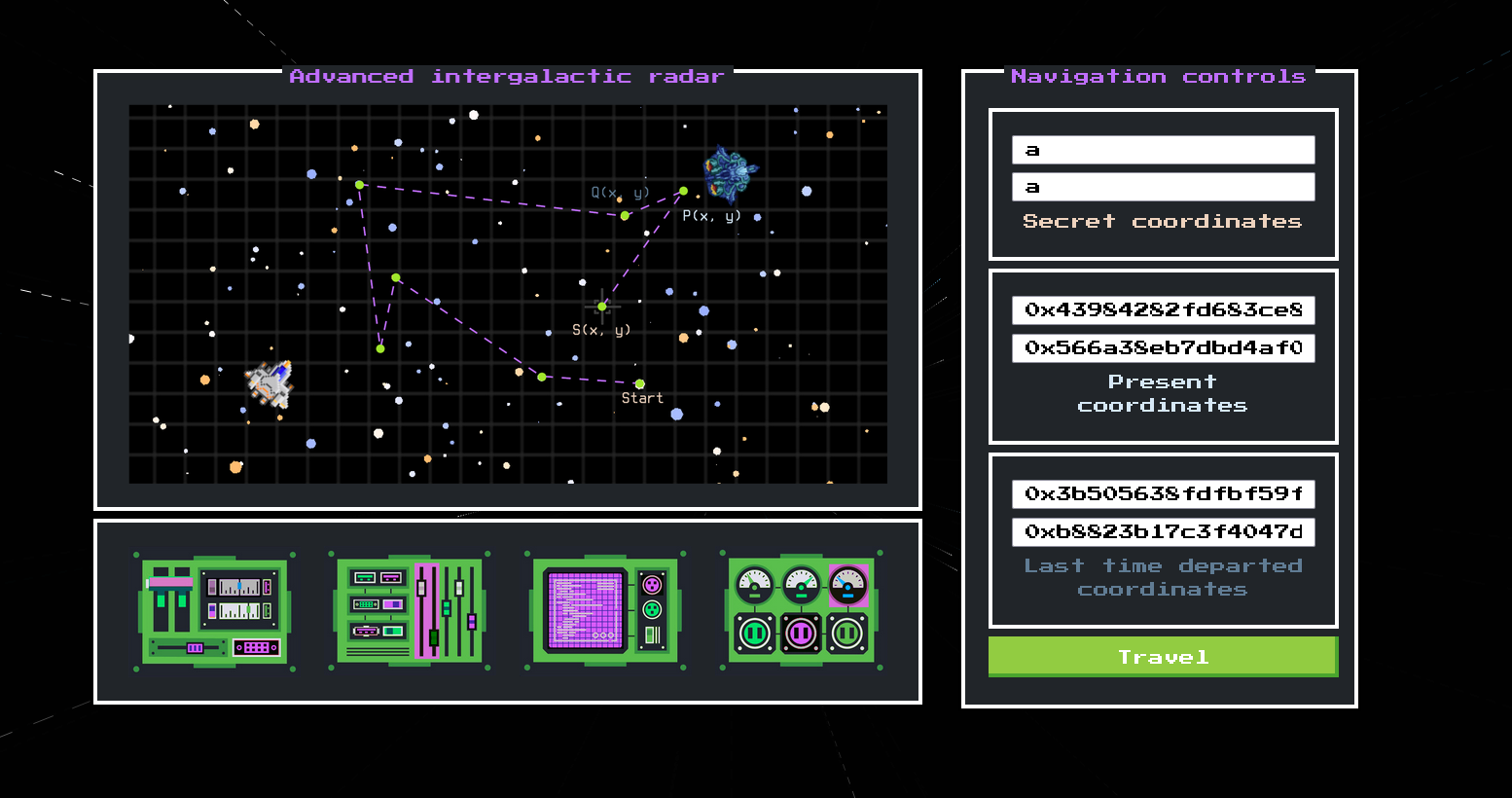
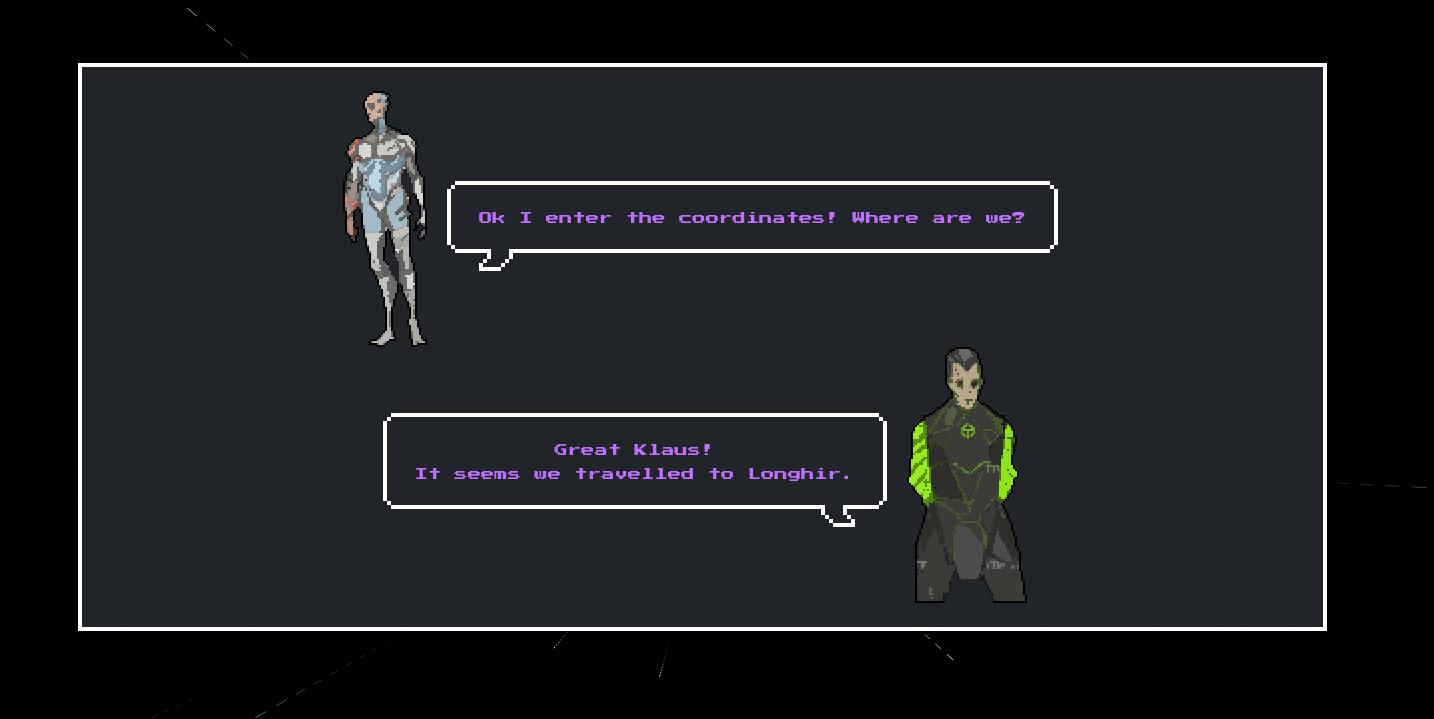
We see that we are redirected to a conversation between Klaus and Bonnie, in which Bonnie tells us that we have travelled to Longhir.
At this point, we need to start looking at the source code to understand how things work.
Analysing the source code 📖
There are 3 files available app.py, navigation.py, utils.py
The utils.py script, generates random locations if we enter the wrong coordinates, so we ignore it.
app.py
We can see that in app.py there is an API provided:
@app.route('/api/coordinates', methods=['GET'])
def coordinates():
    points = {
        'departed_x': hex(Q.x()), 'departed_y': hex(Q.y()),
        'present_x': hex(P.x()), 'present_y': hex(P.y())
    }
    return points


@app.route('/api/get_flag', methods=['POST'])
def get_flag():
    try:
        travel_result = checkDestinationPoint(request.json, P, nQ, E)
        location = generateLocation(travel_result)

        if travel_result:
            return {"location": location, "flag": FLAG}
        else:
            return {"location": location}
    except ValueError as error:
        return {"error": error}


if __name__ == '__main__':
    Q, nQ, P, nP = calculatePointsInSpace()
    app.run(host='0.0.0.0', port=1337, debug=False, use_reloader=False)
We see that in order to get the flag, we must somehow set travel_result = True. The function that sets travel_result is called checkDestinationPoint() and is imported from navigation.py
navigation.py
The basic workflow of the script is:
-
Initialise and define the parameters for the curve.
-
Compute 2 key pairs
(the departed point) and
(the present point).
-
Check if the coordinates given by the player are valid.
-
The secret point (destination point) is generated
and compared with the point we have given. If they match, we get the flag.
Step 1 is translated into code:
from ecdsa import ellipticcurve as ecc
from random import randint

a = -35
b = 98
p = 434252269029337012720086440207
Gx = 16378704336066569231287640165
Gy = 377857010369614774097663166640
ec_order = 434252269029337012720086440208

E = ecc.CurveFp(p, a, b)
G = ecc.Point(E, Gx, Gy, ec_order)
Step 2 is implemented with the calculatePointsInSpace() and generateKeyPair():
def generateKeyPair():
    private = randint(1, 2**64)
    public = G * private
    return(public, private)


def calculatePointsInSpace():
    Q, nQ = generateKeyPair()
    P, nP = generateKeyPair()
    return [Q, nQ, P, nP]
Step 3 is implemented with the checkCoordintates() function. This is just a simple method to see if the points entered by the player are valid.
Step 4 is the win condition. If the secret_point and the point we entered match, we get the flag
    secret_point = P * nQ
    same_x = destination_point.x() == secret_point.x()
    same_y = destination_point.y() == secret_point.y()

    if (same_x and same_y):
        return True
    else:
        return False
To summarise once again:
To get the flag, we need to make checkDestinationPoint() return True. To do this, we must somehow predict what the secret location 
Let’s search for the vulnerability now
Searching for the bugs 👾
One thing that should strike us when we look at the challenge is that the curve appears to use custom parameters. Let us examine these.
a = -35
b = 98
p = 434252269029337012720086440207
There are a lot of vulnerabilities we can check in custom elliptic curves, but really the title of the challenge is a big clue to the attack. If we search for something along the lines of "MOV attack elliptic curves" we will find a lot of resources.
Understanding the vulnerability 🔐
In ECC it is difficult to solve the discrete logarithm problem.
The basic idea of this attack is that the discrete logarithm problem can be moved from an elliptic curve defined over 


from sage.all import *

a = -35
b = 98
p = 434252269029337012720086440207
Gx = 16378704336066569231287640165
Gy = 377857010369614774097663166640

E = EllipticCurve(GF(p), [a, b])

k = 1
while (p**k - 1) % E.order():
    k += 1

print(k)
In our case 
┏━[/tmp]
┗━━ ■ python3 check_k.py
2
Exploitation 🔓
MOV attack
Analysing the source code in the above section, we concluded in step 5 that we must somehow find 


We know that 
A good abstraction of the attack algorithm can be found here.
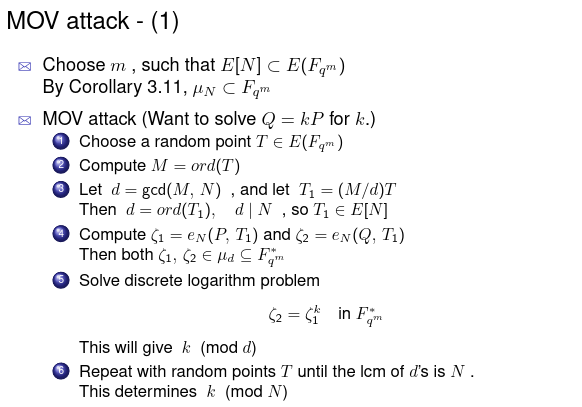
Also a write-up that can help a lot of users with the implementation is this one.
The problem is solved for 


nQ = randomint(1, 2**64)
We will start by working in

Ee = EllipticCurve(GF(p**k, 'y'), [a, b])We choose 
R = Ee.random_point() m = R.order() d = gcd(m, G.order()) B = (m // d) * R After that we take the Weil pairing 

Ge = Ee(G)
Qe = Ee(Q)
n = G.order()
alpha = Ge.weil_pairing(B, n)
beta = Qe.weil_pairing(B, n)
Finally we compute the discrete logarithm in this finite field to find the secret multiplier.
nQ = beta.log(alpha) The complete function is:
def movAttack(G, Q):
    k = 1
    while (p**k - 1) % E.order():
        k += 1

    Ee = EllipticCurve(GF(p**k, 'y'), [a, b])

    R = Ee.random_point()
    m = R.order()
    d = gcd(m, G.order())
    B = (m // d) * R

    assert G.order() / B.order() in ZZ
    assert G.order() == B.order()

    Ge = Ee(G)
    Qe = Ee(Q)

    n = G.order()
    alpha = Ge.weil_pairing(B, n)
    beta = Qe.weil_pairing(B, n)

    print('Computing log...')
    nQ = beta.log(alpha)
    return nQ
There are 2 ways to get the points and calculate the secret coordinates. We can use the UI or the API. I will provide the manual way for aesthetic reasons and then the automatic solver that uses the API.
Manual exploitation
Let’s start by defining the curve:
from sage.all import *


a = -35
b = 98
p = 434252269029337012720086440207
Gx = 16378704336066569231287640165
Gy = 377857010369614774097663166640
E = EllipticCurve(GF(p), [a, b])
Let’s visit the website again.
Gather all of the points:
Px = 0x43984282fd683ce8a6ae3b3be
Py = 0x566a38eb7dbd4af0ed45421cb
Qx = 0x3b505638fdfbf59f732e44805
Qy = 0xb8823b17c3f4047dc20a3afa

P = E(Px, Py)
Q = E(Qx, Qy)
Run the attack for Q:
nQ = movAttack(G, Q)
secret_point = nQ * P
The complete script is:
from sage.all import *

a = -35
b = 98
p = 434252269029337012720086440207

E = EllipticCurve(GF(p), [a, b])


def movAttack(G, Q):
    k = 1
    while (p**k - 1) % E.order():
        k += 1

    Ee = EllipticCurve(GF(p**k, 'y'), [a, b])

    R = Ee.random_point()
    m = R.order()
    d = gcd(m, G.order())
    B = (m // d) * R

    assert G.order() / B.order() in ZZ
    assert G.order() == B.order()

    Ge = Ee(G)
    Qe = Ee(Q)

    n = G.order()
    alpha = Ge.weil_pairing(B, n)
    beta = Qe.weil_pairing(B, n)

    print('Computing log...')
    nQ = beta.log(alpha)
    return nQ


Gx = 16378704336066569231287640165
Gy = 377857010369614774097663166640

Px = 0x43984282fd683ce8a6ae3b3be
Py = 0x566a38eb7dbd4af0ed45421cb

Qx = 0x3b505638fdfbf59f732e44805
Qy = 0xb8823b17c3f4047dc20a3afa

G = E(Gx, Gy)
P = E(Px, Py)
Q = E(Qx, Qy)

nQ = movAttack(G, Q)
secret_point = nQ * P

print(hex(secret_point[0]))
print(hex(secret_point[1]))
And the output:
┏━[/tmp]
┗━━ □ python3 exploit.py
Computing log...
0x34b15c6cdfc3233e1a0490134
0x57832f1e17a296d194cceefc3
Entering them to the secret coordinates field.
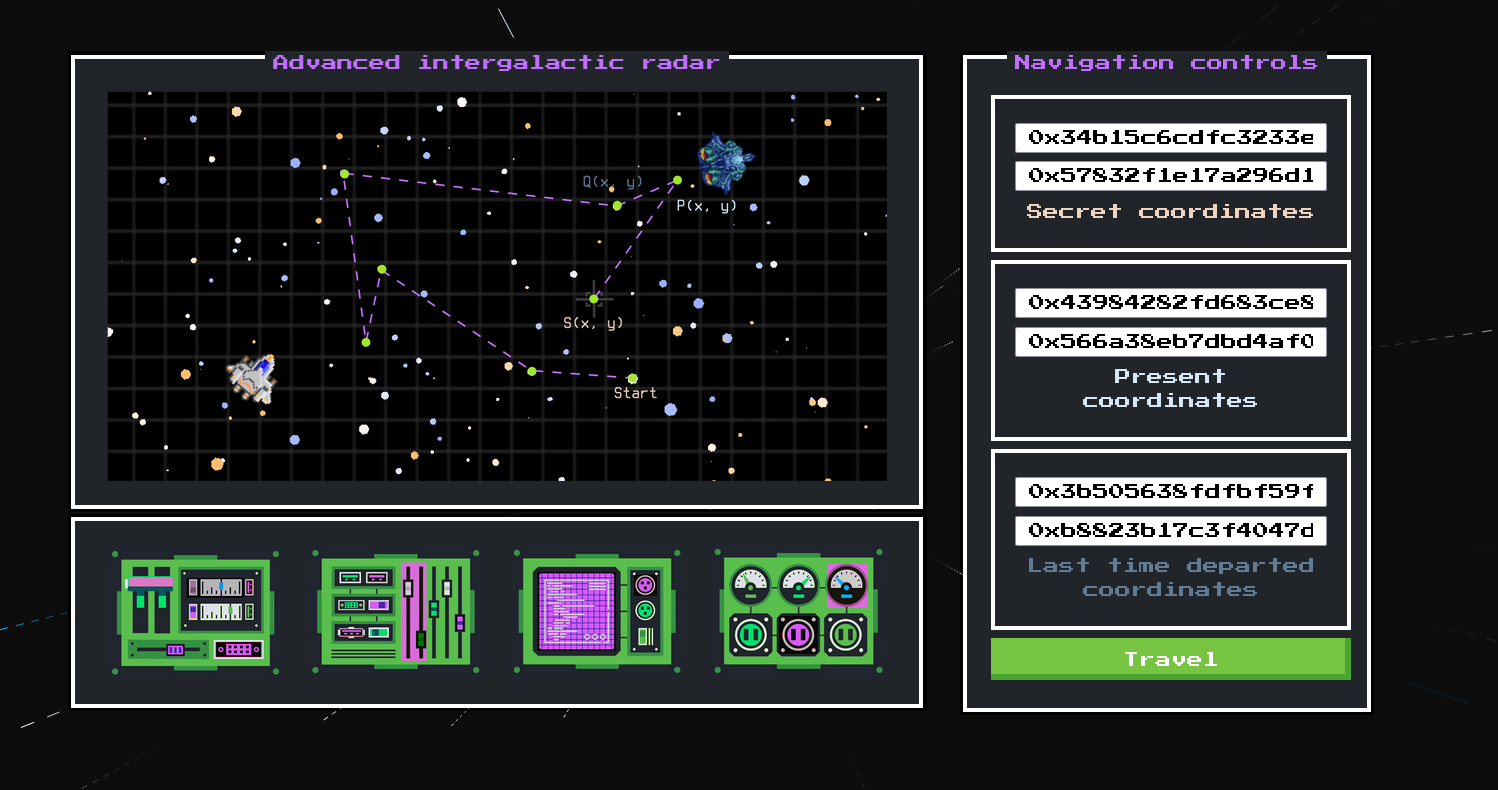
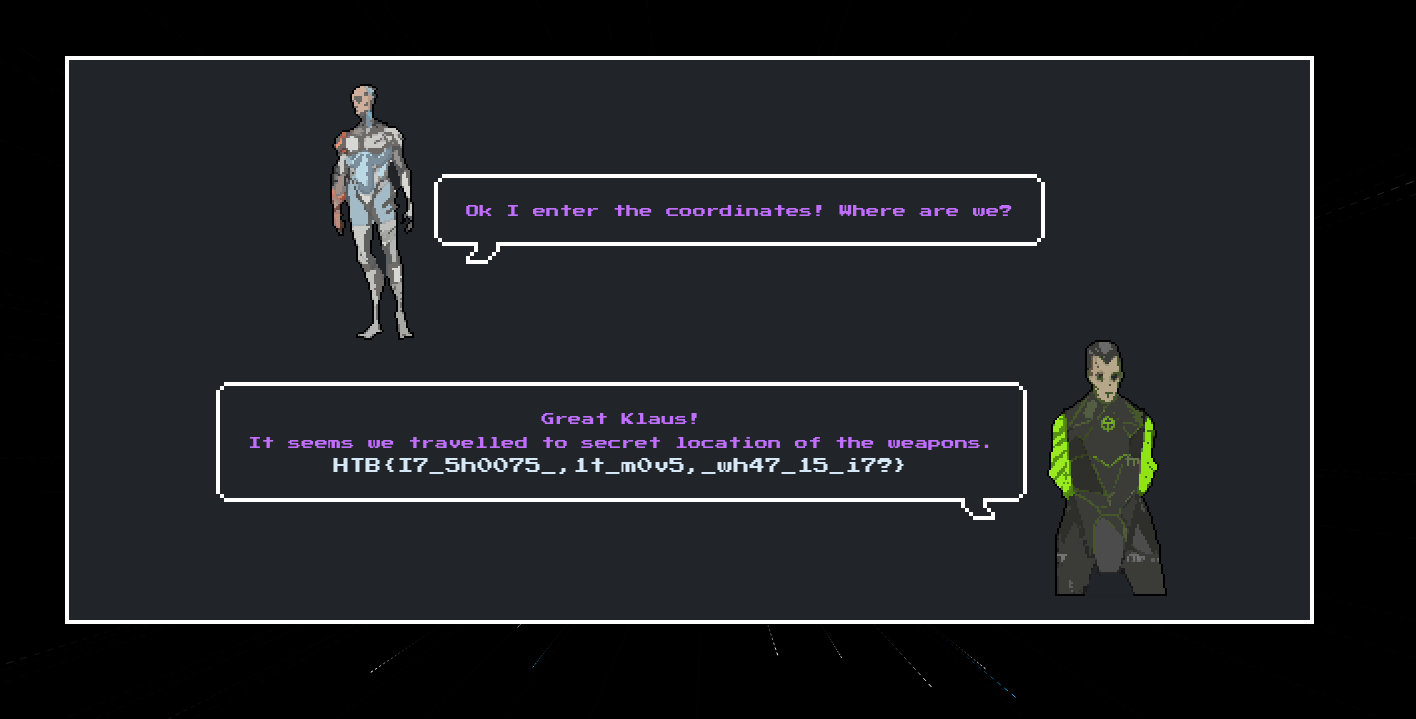
Give us the flag.
Automated exploitation
The automated solver that uses the API is:
from sage.all import *
import requests


def movAttack(G, Q):
    k = 1
    while (p**k - 1) % E.order():
        k += 1

    Ee = EllipticCurve(GF(p**k, 'y'), [a, b])

    Ge = Ee(G)
    Qe = Ee(Q)

    R = Ee.random_point()
    m = R.order()
    d = gcd(m, G.order())
    B = (m // d) * R

    assert G.order() / B.order() in ZZ
    assert G.order() == B.order()

    n = G.order()
    alpha = Ge.weil_pairing(B, n)
    beta = Qe.weil_pairing(B, n)

    print('Computing log...')
    nQ = beta.log(alpha)
    return nQ


url = 'http://127.0.0.1:1337/'

a = -35
b = 98
p = 434252269029337012720086440207
Gx = 16378704336066569231287640165
Gy = 377857010369614774097663166640

E = EllipticCurve(GF(p), [a, b])
print("Elliptic Curve defined...\n")

coordinates = requests.get(url + 'api/coordinates')

departed_x = coordinates.json()['departed_x']
departed_y = coordinates.json()['departed_y']
print("Got Departed point coordinates!!\n")
print(f" X: {departed_x}")
print(f" Y: {departed_y}\n")

present_x = coordinates.json()['present_x']
present_y = coordinates.json()['present_y']
print("Got Present point coordinates!!\n")
print(f" X: {present_x}")
print(f" Y: {present_y}\n")

G = E(Gx, Gy)
P = E(present_x, present_y)
Q = E(departed_x, departed_y)

print("Calculating private key using MOV attack...\n")
nQ = movAttack(G, Q)
print("Private key found!!\n")
print(f"nQ: {hex(nQ)}\n")

secret_point = nQ * P
print("Calculated Destination point!!\n")
print(f"X: {hex(secret_point[0])}")
print(f"Y: {hex(secret_point[1])}\n")

payload = {
    'destination_x': hex(secret_point[0]),
    'destination_y': hex(secret_point[1])
}

flag = requests.post(url + 'api/get_flag', json=payload)
print("Sending coordinates...")

flag = flag.json()['flag']
print("Got flag...\n")
And that’s a wrap for this challenge write-up!